Ann de Wees Allen
•
•
•
•
•
•
|
Direct
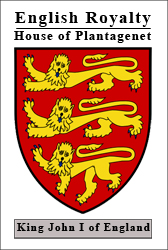
descendant of King John I of England (1167 AD).
Great, great, great (x 23) granddaughter of Eleanor
of Aquitaine, Queen of France and England.
Generational Line of the House of Plantagenet.
Named after Cornelius DeWees’s daughter, Ann
De Wees, who founded De Wees Island off the coast
of Charleston.
Great, great, great (x 21) granddaughter of the Sovereign
Prince of Wales (1232 AD), Llewellyn Gryffyth.
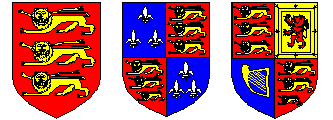
Royal Family Coat of Arms: Plantagenet, De Wees, Darlington |
King
John I of England (1166-1216)
•
•
•
•
•
•
•
• |
Reigned
as King of England from April 6, 1199 until his death.
Descended from William the Conqueror (b. 1027)
Youngest son of Henry II an Eleanor of Aquitane.
Succeeded to the throne as the younger brother of King
Richard I (Richard the Lionhearted).
English Royal House of Plantagenet.
Descended from William the Conqueror (b. 1027)
Pope Innocent III and King John I had a disagreement
about who would become Archbishop of Canterbury which
lasted from 1205 until 1213.
King John Signs the Magna Carta.
The
Magna Carta was signed in June 1215 between
the barons of Medieval England and King John.
"Magna Carta" is Latin and means "Great
Charter". The Magna Carta was
one of the most important documents of Medieval
England |
|
Children
of King John I of England
•
•
•
•
•
•
|
Henry
III
Richard,
Earl of Cornwall
Joan,
Queen of Scots
Isabella,
Holy Roman Empress
Eleanor,
Countess of Leicester
King John’s mother was Eleanor of Aquitaine (1122-1204),
the Queen of both France and England. |
Eleanor
of Aquitaine (1122 – April 1, 1204)
•
•
•
•
|
Queen
of France and England.
Mother
of King John of England.
One
of the wealthiest and most powerful women in Europe
during the High Middle Ages.
Queen consort of both France and England in turn. She
is well known for her involvement in the Second Crusade.
|
PRINCE OF WALES (1246-1282)
LLEWELLYN AP GRUFFUDD (c. 1228-1282)
Llewelyn ap Griffith. Llywelyn or Llewelyn ap Gruffydd
(hl?wel'in äp grif'ith, luel'in) , d. 1282, Welsh prince,
grandson of Llywelyn ap Iorwerth.
The last native Prince of Wales
Father:
Grandfather:
|
Llywelyn
Fawr the Great, Prince of Wales, 1194-1240
Llywelyn the Great
Iorwerth Drwyndwn |
The present Prince of Wales is 21st in the line, counting
several who were never formally invested. He can trace
his descent back through the Tudors to the original
Princes of Wales, of whom the last native Prince of
Wales was Llywelyn ap Gruffydd (1246-82).
|
| 844-878 |
Rhodri
the Great |
| 878-916 |
Anarawd
(son of Rhodri) |
| 916-950
|
Hywel
Dda, the Good |
| 950-979 |
Iago
ab Idwal (or Ieuaf) |
| 979-985 |
Hywel
ab Ieuaf, the Bad |
| 985-986
|
Cadwallon
(his brother) |
| 986-999 |
Maredudd
ab Owain ap Hywel Dda |
| 999-1008
|
Cynan
ap Hywel ab Ieuaf |
| 1018-1023 |
Llywelyn
ap Seisyll |
| 1023-1039 |
Iago
ab Idwal ap Meurig |
| 1039-1063 |
Gruffydd
ap Llywelyn ap Seisyll |
| 1063-1075 |
Bleddyn
ap Cynfyn |
| 1075-1081 |
Trahaern
ap Caradog |
| 1081-1137 |
Gruffydd
ap Cynan ab Iago |
| 1137-1170
|
Owain
Gwynedd |
| 1170-1194
|
Dafydd
ab Owain Gwynedd |
| 1194-1240 |
Llywelyn
Fawr, the Great |
| 1240-1246 |
Dafydd
ap Llywelyn |
| 1246-1282 |
Llywelyn
ap Gruffydd ap Llywelyn |
|
DE WEES ROYAL FAMILY
The
specific lineage of Dr. Ann de Wees Allen’s family spans
13th generations of De Wees’ (from 1563) with family
roots dating to 1200 AD, 740 generational De Wees’,
and 25 generations of Royal Plantagenets from 1122 AD. Not
all of the De Wees family is related to the Royal family,
as only one generational line of the de Wees family can be
traced through legal records (UK Royal Families/De Wees Lineage)
to the Royal Plantagenet line (1122 AD)*.
The
De Wees family (in the Ann de Wees Allen line) settled in
England at the beginning of the reign of Henry VIII. The De
Wees Royal Coat of Arms; the Earl of Warwick Coat of Arms
(1269 AD), Esse Quam Videri, and the Prince of Wales cup and
Seal are in the possession of descendent Ann de Wees Allen
(Washington, D.C.).
*
Note that it is illegal to claim generational lineage
to the Royal family if has not been fully documented.
Not all of the De Wees lineage is related to the Royal
family. The lineage of Ann de Wees Allen has been fully
documented by legal authority. Attempts to copy or utilize
the data found on this website related to Royal lineage
require written authorization from the authors at this
site.
Copyrights
and trademarks to specific information on this website
apply and are subject to Federal lawsuits for infringement. |
DE
WEES ROYAL FAMILY IN AMERICA :
Ann
de Wees Allen’s family founded De Wees Island in Charleston,
South Carolina.
Cornelius
de Wees and his daughter Ann de Wees (whom Dr. Allen is named
after) lived on De Wees island in their plantation home until
Cornelius’ death in 1786.
Charleston, S.C. was founded in 1670 (then called Charles
Town) named in honor of King Charles II of England. After
Charles II (1660-85) was restored to the British throne after
Oliver Cromwell’s Protectorate, he granted the chartered
Carolina territory to eight of his loyal friends, known as
the Lords Proprietor, in 1663.
By 1680, the settlement of Charleston had grown, joined by
others from England. Charleston was the center for further
expansion and the southernmost point of English settlement
during the late 1600s. Charleston represented civilization
to the colonials. In June of 1776, Charleston found itself
embroiled in the Southern Campaign of the Revolutionary War
and handily defeated the attacking British fleet.
Cornelius de Wees played a major role in the Revolutionary
War. He built and launched his first ship from de Wees island
on August 8, 1771. Following the activities on De Wees island
against the British, King George said “I
will drive the De Wees’ out of Charleston!” (History
of South Carolina)
“It
has been our particular pride that it was from De Wees island,
by our kinsmen, that the British transport ship Glascow was
destroyed.” On April 28, 1782, King George posted a
proclamation “To the Soldiery of the Enemy - The De
Wees family is ordered out of Charleston because of their
Rebel activities.”
De Wees is now a private island with uncrowded wild beaches,
dedicated to the preservation of its unique coastal ecology.
It is a haven for wild birds and endangered species, and has
won numerous environmental and ecological awards. A history
of Cornelius and De Wees Island may be seen at www.deweesisland.com
(click on Mission, see History of De Wees Island).
Since the Revolutionary War, Dr. Allen’s family has
been very active in the DAR (Daughters of the American Revolution).
Dr. Allen says that Cornelius de Wees’ determination
runs in her family and points out that she and her namesake,
Ann de Wees Allen (born in 1777), share the same birthday.
ALLEN FAMILY FOUNDS ALLENDALE, SOUTH CAROLINA
Allendale, SC, is named after Paul H. Allen, born
January 1813, who founded Allendale and was the first postmaster
of the settlement subsequently called Allendale, SC in 1849
(then part of Barnwell County). (History of SC by Yates
Snowden, Vol 5, p243; A Guide to the Palmetto State, SC Writers
Project, p 453). Paul Allen died March 1909 and is buried
in the Swallow Savannah Cemetery, Allendale, SC.
John Allen, born in Allendale, S.C. married Ann (Nancy) DeWees
(Ann DeWees Allen/1777), daughter of Cornelius DeWees and
Sarah Minors, of DeWees Island in Charleston. John Allen served
in the South Carolina Militia during the Revolutionary War
(Daughters of the American Revolution DAR, census records,
Wiregrass GA Vol II, page 25-26.)
The family home, called “The Grove” was built
in Allendale before the Civil War. The estate survived the
Civil War and was left to its heirs Ann de Wees Allen of Washington,
D.C. and William Humphries of New Orleans, who married the
Queen of the Mardi Gras, Mignon Faget. Ann de Wees
Allen was a Flower Girl in the marriage ceremony of Mignon
Faget and William Humphries.
The Allendale home contained pre-Civil War furniture, the
1st piano in the South, antiques, and family papers, including
Civil war documents, and handwritten letters from author O.
Henry, who married into the Allen family.
|